
Time to Think by Nancy Kline: Listening to Ignite The Human Mind
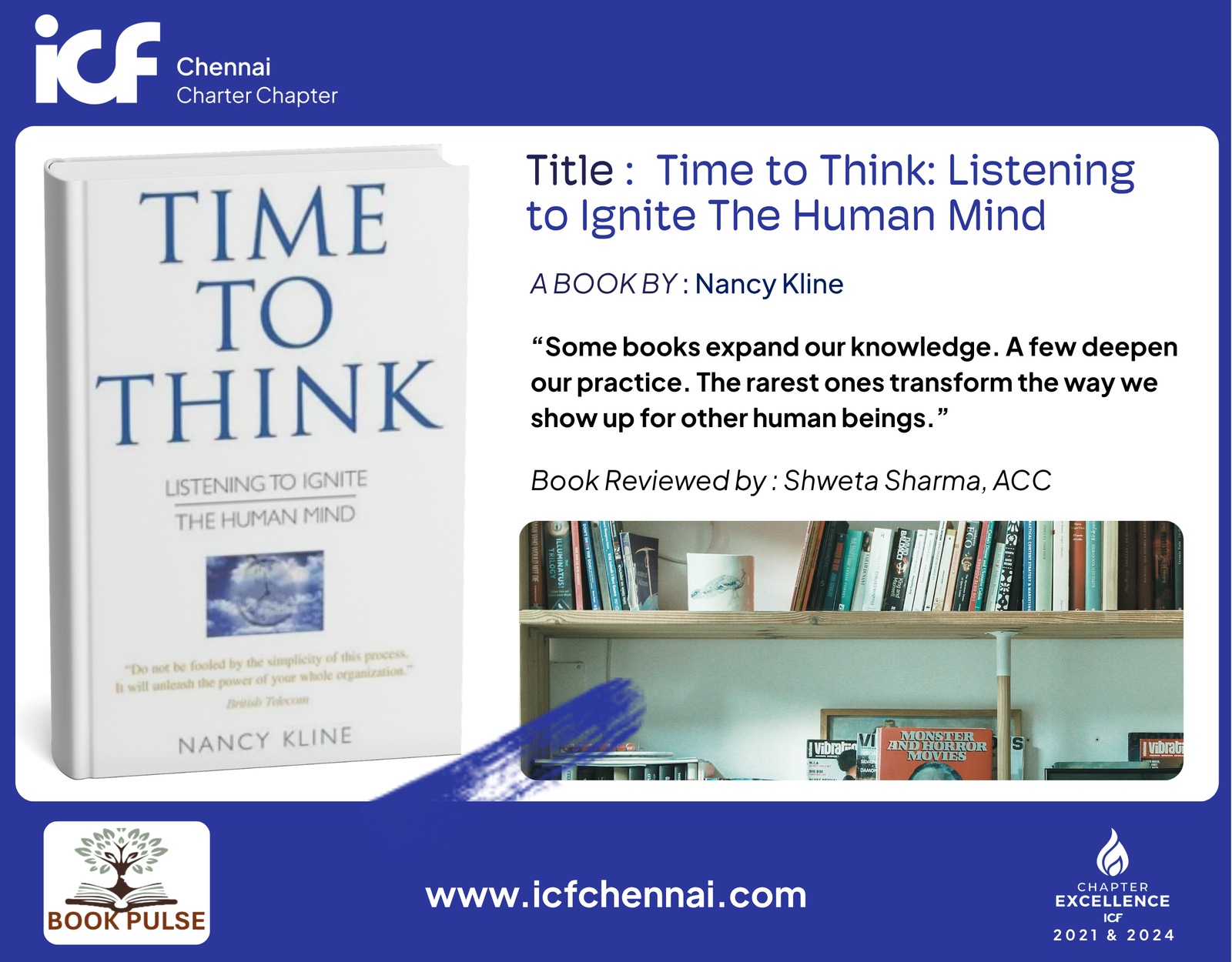
Book review by Shweta Sharma
There are books that introduce new ideas, and then there are books that quietly alter the way we see ourselves and those around us. Time to Think by Nancy Kline belongs firmly in the latter category.
At first glance, its premise seems almost too simple: the quality of everything we do depends on the quality of the thinking we do first. Kline goes a step further, proposing a profound idea—that “the quality of our thinking depends largely on the quality of the attention we receive from others.”
In an age where speed is celebrated, interruptions are commonplace, and conversations often become contests of opinion, this idea feels both radical and deeply human.
As coaches, we are trained in powerful questioning, active listening, and presence. Time to Think reminded me that these are not isolated competencies but expressions of something more fundamental. Before a powerful question comes the quality of attention we offer. Before insight emerges, there must be psychological safety. Before transformation, there must be permission to think.
One of the book’s most memorable lines captures this beautifully:
“The quality of your attention determines the quality of other people’s thinking.”
It is a deceptively simple statement with far-reaching implications. We often believe our value lies in offering ideas, advice, or solutions. Kline gently challenges that assumption, suggesting that our greatest contribution may instead be our willingness to listen—without interrupting, correcting, rescuing, or mentally rehearsing our response.
Another enduring contribution of the book is the concept of the Thinking Environment—ten interdependent components that enable people to think independently and well:
Attention, Equality, Ease, Appreciation, Encouragement, Feelings, Information, Diversity, Incisive Questions, and Place.
Individually, these ideas are familiar. Collectively, they become a philosophy that reshapes our understanding of coaching, leadership, education, and relationships.
Among these, Incisive Questions resonated with me the most. Rather than encouraging clever questions, Kline invites us to uncover the limiting assumptions beneath a person’s thinking. Once those assumptions are recognised, the question that truly matters often emerges naturally.
Another line that stayed with me is:
“To be listened to is so close to being loved that most people cannot tell the difference.”
Few sentences capture the emotional significance of listening with such simplicity. Listening, in Kline’s view, is not merely a communication skill; it is an act of respect and belief in another person’s capacity to think for themselves.
This perspective has subtly but significantly influenced my coaching and facilitation. I became more aware of how easily I interrupted—not always with words, but with assumptions, interpretations, or the urge to move a conversation forward. I also found myself becoming more comfortable with silence, trusting that insight often arrives in the pauses we are tempted to fill.
The impact extended beyond coaching sessions. In workshops, I became less focused on delivering content and more intentional about creating environments where participants could reflect, contribute, and think without fear of judgement. In everyday conversations, I noticed how quickly listening gives way to reassurance or advice. Time to Think reminded me that people rarely need us to think for them; they need us to trust that they can think for themselves.
That, perhaps, is the book’s greatest gift.
Kline’s writing is thoughtful and persuasive without being prescriptive. Drawing on observation, experience, and practical examples, she builds a compelling case for independent thinking as something that flourishes—or diminishes—in the presence of others. It is a book that invites reflection rather than demanding agreement.
Although widely read in coaching circles, this is not a book exclusively for coaches. Leaders will discover a model of influence rooted less in expertise and more in creating conditions for others to contribute. Educators, HR professionals, facilitators, parents, and anyone who values meaningful conversations will find ideas that are both practical and transformative.
If there is one lesson I will carry forward, it is this: meaningful change does not always begin with better advice or even better questions. More often, it begins with better attention.
Some books expand our knowledge. A few deepen our practice. The rarest ones transform the way we show up for other human beings.
For me, Time to Think is one of those rare books. Its greatest gift is not simply that it teaches us to coach more effectively, but that it reminds us to be fully present—with our clients, our colleagues, our families, and ourselves. In a world overflowing with noise, that may be one of the most valuable gifts we can offer another human being.

Shweta Sharma
The views and opinions expressed in guest posts featured on this blog are those of the author and do not necessarily reflect the opinions and views of the International Coach Federation (ICF). The publication of a guest post on the ICF Blog does not equate to an ICF endorsement or guarantee of the products or services provided by the author.
Additionally, for the purpose of full disclosure and as a disclaimer of liability, this content was possibly generated using the assistance of an AI program. Its contents, either in whole or in part, have been reviewed and revised by a human. Nevertheless, the reader/user is responsible for verifying the information presented and should not rely upon this article or post as providing any specific professional advice or counsel. Its contents are provided “as is,” and ICF makes no representations or warranties as to its accuracy or completeness and to the fullest extent permitted by applicable law specifically disclaims any and all liability for any damages or injuries resulting from use of or reliance thereupon.