
The Brain: The Story of You by David Eagleman
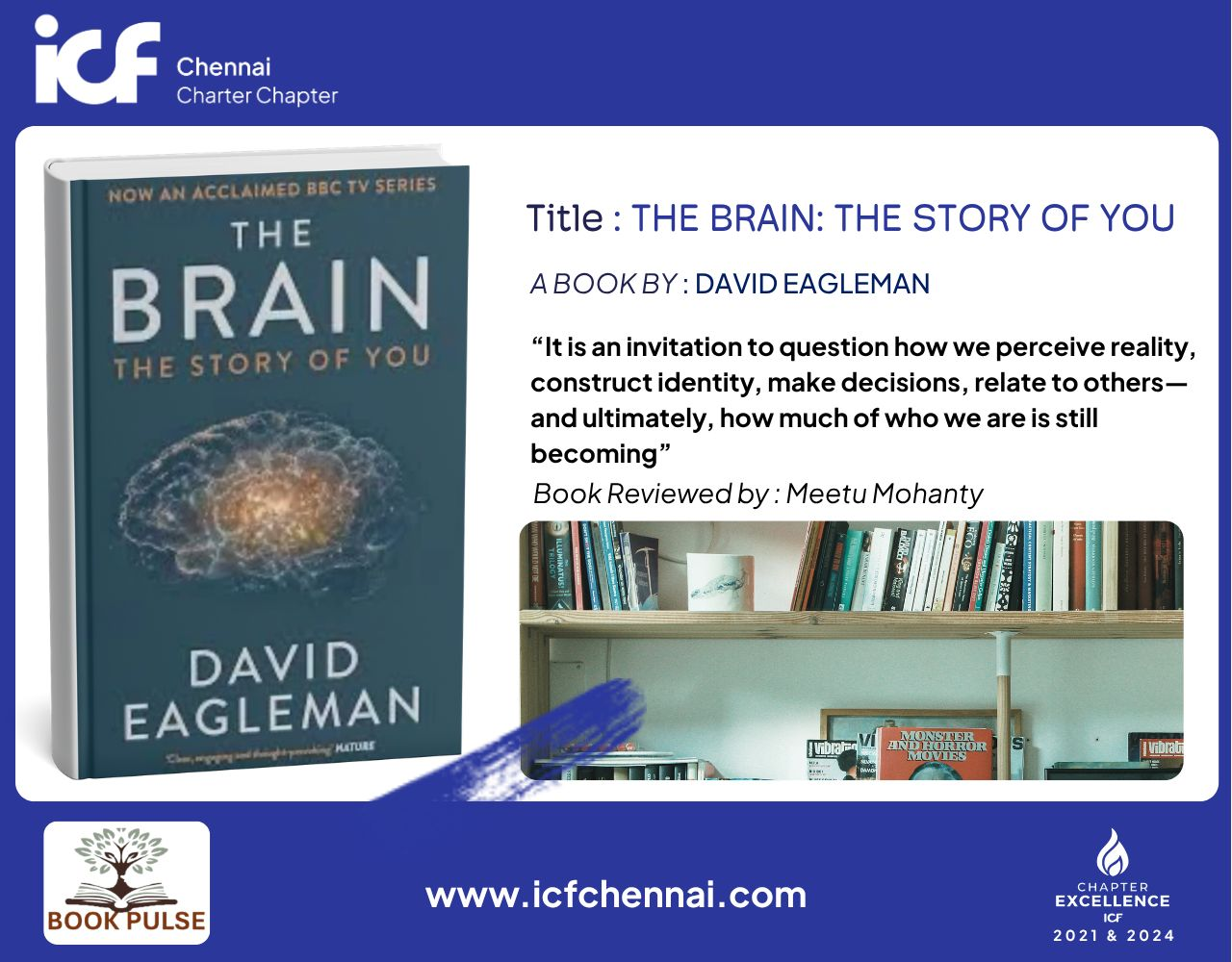
Book reviewed by Meetu Mohanty
What if exploring your inner cosmos could change the way you experience the outer one?
And what if the most extraordinary universe we will ever explore lies much closer to home—inside our own heads?
I have read this book three times, and what amazes me is that each time, I encounter it with a newness.
Perhaps the book hasn’t changed—
but something in me has.
The book begins with a question many of us associate with spirituality and self-discovery:
Who am I?
It was also central to my own coach-training journey.
From here, neuroscientist David Eagleman takes us on a fascinating journey into the brain—and calls it:
The Story of You.
Imagine a leader walking into an important meeting after a difficult morning. Nothing dramatic happens, yet she feels unusually defensive when a colleague questions her decision.
Why might another person experience the same question as simple curiosity?
Eagleman helps us understand that neither person experiences the meeting as a blank slate. The brain continuously processes sensory information, draws on past experiences, predicts what might happen next and assigns meaning to what we encounter.
The brain doesn’t simply receive reality.
It actively constructs our experience of it.
The leader may not be responding only to the question. Her brain could be drawing upon earlier experiences of criticism, rejection, success, failure, authority or belonging.
The colleague sees a question.
Her brain may perceive a threat.
Both experiences feel real.
What we call reality may be reality filtered through an extraordinarily complex prediction system.
Our perceptions are influenced by what we notice, remember, expect and the neural pathways shaped by our experiences.
Even those moments when we suddenly produce a brilliant idea may not be as sudden as they appear. Beneath conscious awareness, vast neural processing is taking place—making associations, connecting information, recognizing patterns and generating possibilities. The insight simply becomes conscious at a particular moment.
The book is filled with thought experiments that challenge our certainty about what we see, remember and believe.
I found myself wondering what would happen if we introduced some of these ideas much earlier in life.
Imagine a classroom where children experience an exercise demonstrating that what they perceive may not always be the complete picture. Instead of simply learning the answer, they learn to question perception, consider another perspective and recognize that their version of reality may not be the whole truth.
Imagine what such an understanding could do for the next generation.
Perspective-taking can be an antidote to certainty.
When the world becomes divided into us and them, the brain can simplify complexity. Labels become shortcuts. Differences can become threats. Repeated narratives can strengthen associations until another human being is no longer experienced as an individual, but as a category.
Eagleman explores dehumanization and its role in some of humanity’s darkest acts.
If perception can be shaped, memories influenced and behaviour manipulated, understanding the brain is not simply an academic pursuit.
It becomes an ethical one.
It reminds us to pause before assuming our interpretation is the only truth—and to see the human being behind the label.
This also made me think differently about leadership.
I have often heard leaders say they make decisions with their “head, not their heart.”
But the brain doesn’t work quite so neatly.
Imagine a CEO preparing to announce a major restructuring. She studies financial forecasts, market realities and organizational priorities. The decision appears rational and entirely data-driven.
Yet beneath the numbers, her brain is also processing memories, values, fear, empathy, responsibility and anticipated consequences.
The prefrontal cortex supports reasoning, planning and evaluating consequences, but it doesn’t operate in isolation from neural systems involved in emotion, memory and motivation.
The emotional brain is already in the room.
The question isn’t whether emotions influence decisions.
It is whether we are aware of how they do.
As a Coach, this is where The Brain: The Story of You becomes deeply personal.
Understanding the brain allows us to become curious about our patterns rather than simply judging them.
Why did I react that way?
What did my brain interpret?
What previous experience might have shaped this response?
What else could be true?
That curiosity can transform how we understand ourselves—and others.
And then, just when you think the journey has gone deep enough, Eagleman takes us towards the future.
Ever heard someone say, “I don’t need anyone!”?
The neuroscience suggests otherwise. Human brains are profoundly social, shaped by relationships and interaction.
As Eagleman puts it, “Our neurons require other people’s neurons to thrive and survive.”
So perhaps the question is no longer simply:
Who am I?
But:
Who are we becoming?
The final chapter opens possibilities that sound almost like science fiction—digital immortality, cryopreservation and technologies that could influence the future of the human brain.
For a non-medical reader like me, these possibilities are fascinating, exhilarating and unsettling.
I admire Eagleman’s ability to make complex neuroscience accessible while leaving us with questions far bigger than the answers.
What happens when consciousness goes missing?
Who is really in control?
Can memories be altered?
And perhaps the most mind-boggling possibility:
Could we someday implant memories that never happened?
The Brain: The Story of You is not simply a book about the brain.
It is an invitation to question how we perceive reality, construct identity, make decisions, relate to others—and ultimately, how much of who we are is still becoming.
Read it for the science.
Read it for the self-awareness.
Read it for the possibility of a better world.
I invite you to read the book and take the journey yourself, leaving you with one final question:
If the organ that shaped every thought, belief, memory and decision you ever made is still evolving—and we now possess the technology to influence that evolution—what does it truly mean to be human?

Meetu Mohanty
The views and opinions expressed in guest posts featured on this blog are those of the author and do not necessarily reflect the opinions and views of the International Coach Federation (ICF). The publication of a guest post on the ICF Blog does not equate to an ICF endorsement or guarantee of the products or services provided by the author.
Additionally, for the purpose of full disclosure and as a disclaimer of liability, this content was possibly generated using the assistance of an AI program. Its contents, either in whole or in part, have been reviewed and revised by a human. Nevertheless, the reader/user is responsible for verifying the information presented and should not rely upon this article or post as providing any specific professional advice or counsel. Its contents are provided “as is,” and ICF makes no representations or warranties as to its accuracy or completeness and to the fullest extent permitted by applicable law specifically disclaims any and all liability for any damages or injuries resulting from use of or reliance thereupon.