

Coaching the Invisible by Sandhya Mathur
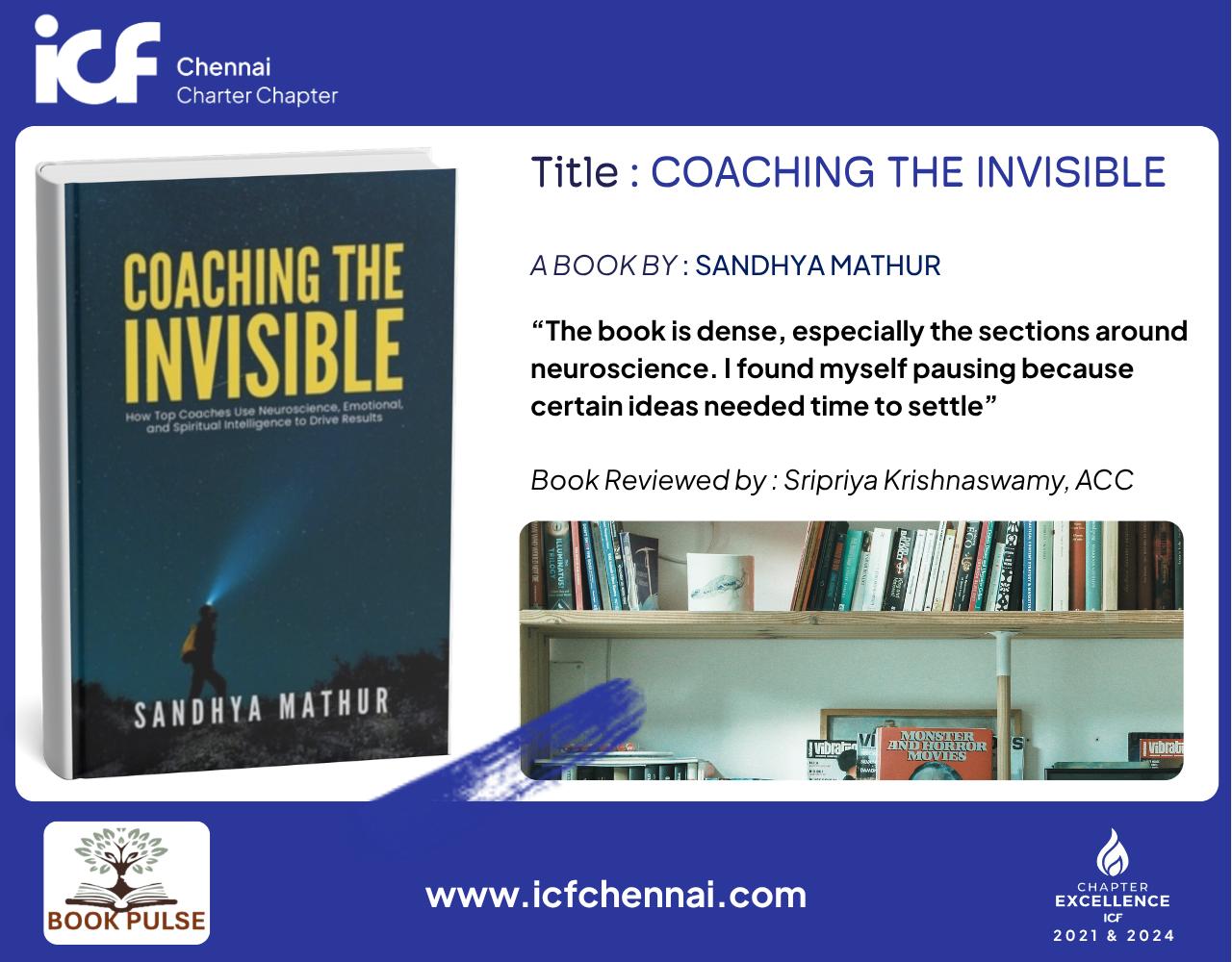
Book review by Sripriya Krishnaswamy
I picked up this book after seeing Marcia Reynolds recommend it on LinkedIn. I was intrigued by the title and was curious about what lies beneath the surface of coaching conversations.
As coaches, we work with words, questions, and presence. But every individual is much more than what they bring to the table, isn’t it? There is a lot of ‘unspoken’ behind, rather beneath how one thinks, feels, and acts…
This is exactly the space that this book addresses.
About the Book
Sandhya Mathur explores how to deepen our coaching beyond the prescribed framework and techniques.
The crux of this book is that some of the most powerful shifts in coaching happen when we blend neuroscience, emotional intelligence, and spiritual wisdom. She explores how a coach can leverage the finer aspects such as emotions, intuition, embracing ambiguity and deepen their presence to enable transformations.
The book is dense, especially the sections around neuroscience. I found myself pausing because certain ideas needed time to settle.
Key Ideas from the Book (Through a Coaching Lens)
This isn’t a chapter-by-chapter summary kind of book. I’ve managed to pick up a few threads that weave together throughout. Here are the ideas that have stayed with me:
- The invisible shapes everything we see.
Most of what drives our clients’ behavior is invisible to them, including their thoughts, emotions, beliefs, nervous system responses running on autopilot. A beautiful analogy, a powerful one at that: “Like a path through the forest, the more we walk a thought, the clearer it becomes.” This book reminded me to listen for what is not said; the emotion beneath the words, the belief behind the resistance, the fear inside the ambition.
- Powerful questions have a design:
She introduces the SEE design lens and talks about questions being expansive, heart-led, and visionary. I tried one shift in a recent session, asking “What would it look like if this felt easy?” instead of “What do you want to do next?” and watched the client’s entire energy change.
- The EQ Lotus and other invisible frameworks.
The book offers visual tools like the EQ Lotus, the Ambiguity Tolerance Framework, and models for working with intuition, silence, and resistance. What struck me is that Sandhya presents these as ways to sense what’s happening beneath a client’s words, not just techniques to apply. One analogy stayed with me: coaches are gardeners of the unseen. We don’t fix, we nurture.
- Neuroscience meets the nervous system.
The book explains why some sessions create lasting change and others don’t. “It’s not always about the insight. It’s whether the nervous system feels safe enough to allow it.” The use of pauses, silence makes the conversation more powerful because it allows a client’s system to settle before moving anywhere.
- The energy of language.
Words don’t just convey meaning; they create states. They can calm, open, or ground. I’ve become more intentional about the words I choose and the space I leave for silence.
The book also touches on the nine emotions in Indian philosophy, tools like the Intuition Integration Model and Silence as Space Model, and how to work with ambiguity rather than rush past it. But what makes it valuable isn’t the number of tools but it’s how they all connect into a way of being as a coach.
My Experience Reading the Book
This is not a quick read. It is also not a book I will read once and set aside. I expect to return to it as my practice deepens. It’s not only the ideas presented, it’s how the book engages you in them.
It feels less like moving through chapters, and more like being in dialogue with the practice itself.
The best aspect is that she has embedded Reflective Questions in sections that were of great help to anchor our thoughts as we read each section.
How This Book Has Influenced My Coaching
What stands out about this book is that it does not offer isolated techniques. The ideas connect. One pass with this book, I have noticed a shift in how I hold sessions.
I am mindful of the invisible forces I bring into the sessions. This is equally important as I proceed to co-create these conversations. My focus is on what is being felt, what silence and pauses reveal beyond words, and how to sit with ambiguities and uncertainties that emerge. Most importantly, I’m learning to lean into my intuition and curiosity to guide my conversations.
Here’s what I am carrying forward:
- The invisible elements, such as emotions, beliefs, and nervous system patterns, shape everything visible, yet remain mostly unattended.
- Powerful questions are not just well-structured; they touch something real
- Leaning into intuition can guide you to go deeper
- Words carry energy and create internal states
- Transformation requires emotional safety, not just insight
- Slowing down is often the fastest way forward
Final Reflection
I am glad I picked this book or did it pick me, I wonder? I expect this book will stay with me for a long time.
This book is for practicing coaches at all levels, mentors, and leaders who want to go beyond techniques. It reminds us that coaching is about helping people become conscious enough to choose differently. What I appreciate most is that the book invites responsibility, patience, and deeper awareness.
This is a book that doesn’t ask you to do more. It invites you to notice more. In a space where coaching can sometimes become structured and outcome-driven, this is a gentle reminder: The most meaningful shifts often happen quietly… in spaces we almost overlook.
“The coach is the anchor, the coaching session is the shore; a place the client can return to; a place where they return to themselves.” ~ Sandhya
It leaves me wondering: how might embracing the invisible transform not just coaching, but our wider relationships and ways of being?

Sripriya Krishnaswamy
The views and opinions expressed in guest posts featured on this blog are those of the author and do not necessarily reflect the opinions and views of the International Coach Federation (ICF). The publication of a guest post on the ICF Blog does not equate to an ICF endorsement or guarantee of the products or services provided by the author.
Additionally, for the purpose of full disclosure and as a disclaimer of liability, this content was possibly generated using the assistance of an AI program. Its contents, either in whole or in part, have been reviewed and revised by a human. Nevertheless, the reader/user is responsible for verifying the information presented and should not rely upon this article or post as providing any specific professional advice or counsel. Its contents are provided “as is,” and ICF makes no representations or warranties as to its accuracy or completeness and to the fullest extent permitted by applicable law specifically disclaims any and all liability for any damages or injuries resulting from use of or reliance thereupon.
Beautiful review. Thank you.