

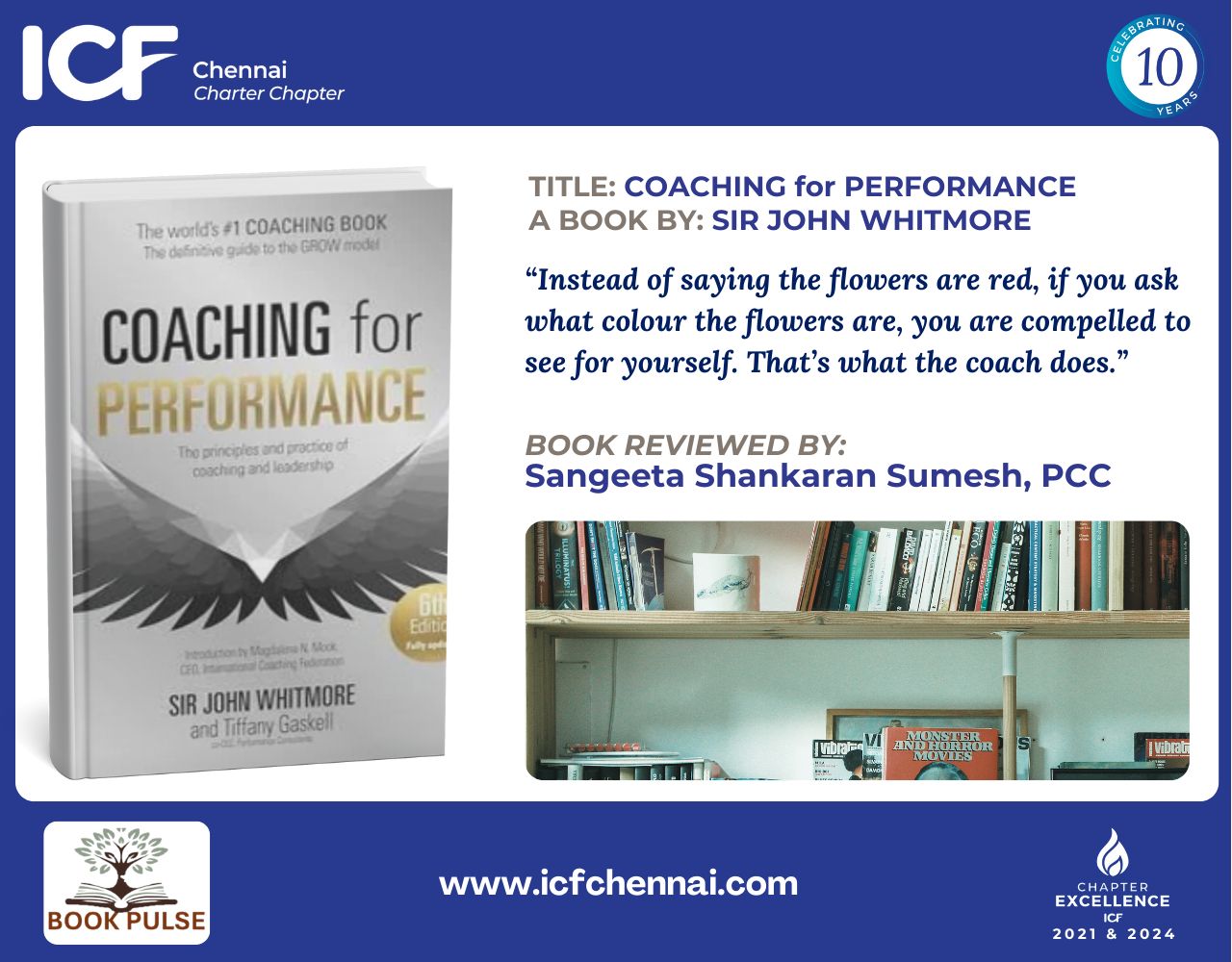
COACHING FOR PERFORMANCE by Sir John Whitmore and Tiffany Gaskell
Reviewed by Dr Sangeeta Shankaran Sumesh
This book covers 3 of my favorite topics- coaching, high performance, and leadership. It highlights the importance and benefits of coaching and how coaching delivers high performance.
What appealed to me are the real-life examples showcasing the impact of coaching, powerful coaching questions, and enabling high performance.
What is Coaching?
The book explains that coaching differs from teaching and mentoring—it focuses on enabling learning and growth, not just sharing knowledge. For example, chess champion Gukesh benefited from working with coach Paddy Upton, who isn’t a chess expert. Coaching empowers individuals by fostering choice, potential, and motivation, helping create collaborative, high-performing workplaces.
Coaching is the enabler & a coaching culture creates the conditions for high performance, such as trust, inner values, quality, learning, service, interdependence, etc.
Coaching is a way of thinking, a way of being. Transformational coaching is the practice of emotional intelligence comprising-
- Self-awareness
- Self-management
- Social awareness &
- Relationship management
Many leaders are busy firefighting & struggling to get the job done. They are unable to devote time to long-term planning, nor able to grow their people. Coaching is a good solution to these.
When should you use coaching?
- When there’s a time constraint
- When the quality of the result matters
- To maximize the learning
- To get real commitment
- For engagement and retention
Coaching can be applied for goal setting, strategic planning, motivating and inspiring, teamwork, problem-solving, performance management, people development, etc.
What does a Coach do?
A coach is not a problem solver, a counselor, a teacher, an advisor, an instructor, nor an expert. A coach is a sounding board, a facilitator, an awareness raiser, and a supporter.
Instead of saying the flowers are red, if you ask what colour the flowers are, you are compelled to see for yourself. That’s what the coach does.
Building High Performance Culture
Ending the blame culture, getting people involved, reducing stress, and increasing personal responsibility build a High Performance Culture at the workplace.
High performance leaders have behaviours that support a culture of trust, adaptability & high engagement. Their teams often exceed expectations. It focuses on creating a safe environment for open and honest conversations, supports a resilient & transparent culture.
Impact of Coaching on high performance
When the leader acts as a coach, it enables high performance. We have been told by our parents, teachers, and bosses what to do. In turn, we also tell people what to do. While it’s quick and easy, the dictator is in control. A dictator upsets and demotivates employees. Employees behave differently when the dictator’s back is turned. We do not remember something that we’re told because people learn best through experience.
But coaching is on a different plane. The leader listens to the answers of the coaching questions & it’s non-threatening & supportive. No behaviour changes occur when the leader’s absent.
Coaching Attributes
- Asking Powerful questions
In all ball sports, it is certainly vital to watch the ball, but does the command to watch the ball cause you to do so? No. If it did, many more of us would be far better at our sport.
Instead, by asking powerful questions like
- Are you watching the ball?
- Which way is the ball spinning?
- How high is it? etc.
Helps the cause better because it compels the player to watch the ball.
Asking open-ended questions promotes awareness. Example-
- What do you want to achieve?
- What’s stopping you?
- What’s helping you?
- Who could help you?
- Active listening
When you hear what is said, the feelings are conveyed. Intuition will be the best guide. Listen to the words and the tone of voice. Pay attention to the body language, energy levels & other emotional signals.
- Feedback
The following are different ways of conveying feedback on a report that was not prepared well. Point one is the least effective manner of sharing feedback, while point 5 is the most effective way of giving feedback when the leader acts as a coach.
- You are useless
- This report is useless
- The content of the report is good, but the presentation is downmarket
- How do you feel about the report?
- What are you most pleased with in the report? What would you do differently?
Coaching teams for high performance
It is even more difficult to get the best out of teams because of Global mobility, remote working, continuous forming & re-forming of teams, geographies, complex business challenges etc.
Practical ways of fostering a coaching culture in teams include-
- Agree on ground rules
- Educate on communication skills & team dynamics
- Agree on common goals
- Hold team discussions
- Have support systems in place
- Arrange structured social time together
- Common interest outside work
- Learn a new skill
ROI of Coaching
- Improved performance, productivity, and career development
- Improved relationships and engagement
- Improved job satisfaction & retention
- Increased innovation
- Better use of people and knowledge
- People who will go the extra mile
- Great agility and adaptability
- Build high performance culture
- Life skill
Why should a Coach read this book?
If you are a Coach, here’s how this book will help you
- You can use the points mentioned in this book to explain the importance and benefits of coaching.
- There are many sample thought-provoking questions mentioned in this book, which you can use with your clients.
- You can effectively pitch to a potential client, as this enables you to clearly articulate the ROI of coaching and also cite this book as an example.
Concluding Remarks
The essence of this book, in my opinion, is:-
- The examples of coaching conversations given in the book help understand the impact coaching creates.
- The importance of working with a coach who has been trained/credentialed by recognized bodies.
- The impact of coaching makes one think, “How can I get better?”

Sangeeta Shankaran Sumesh
The views and opinions expressed in guest posts featured on this blog are those of the author and do not necessarily reflect the opinions and views of the International Coach Federation (ICF). The publication of a guest post on the ICF Blog does not equate to an ICF endorsement or guarantee of the products or services provided by the author.
Additionally, for the purpose of full disclosure and as a disclaimer of liability, this content was possibly generated using the assistance of an AI program. Its contents, either in whole or in part, have been reviewed and revised by a human. Nevertheless, the reader/user is responsible for verifying the information presented and should not rely upon this article or post as providing any specific professional advice or counsel. Its contents are provided “as is,” and ICF makes no representations or warranties as to its accuracy or completeness and to the fullest extent permitted by applicable law specifically disclaims any and all liability for any damages or injuries resulting from use of or reliance thereupon.
Wonderful review Sangeetha, and pithy, powerful takeaways. Its already in my shopping cart!