

The Way of Integrity by Martha Beck
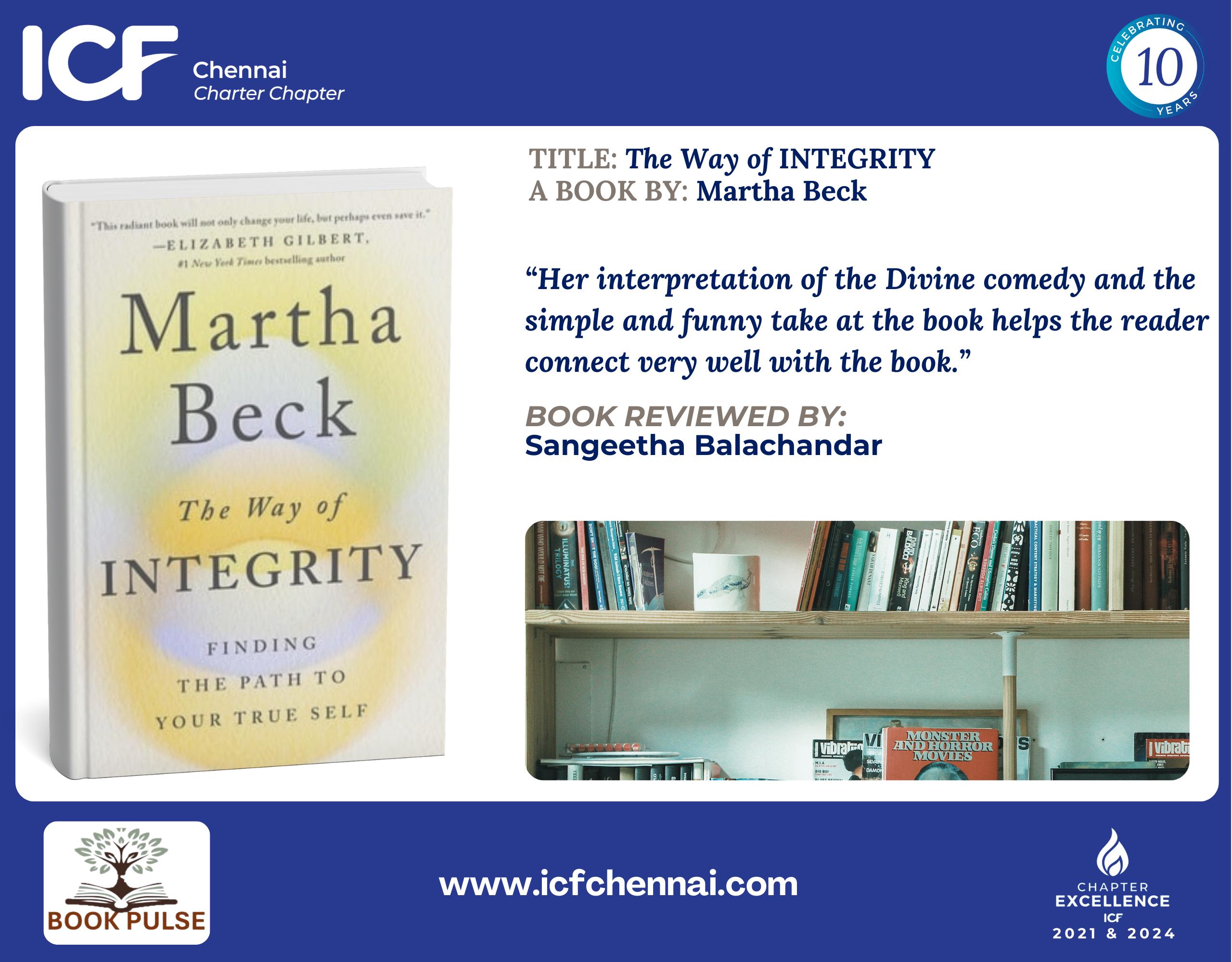
Book review by Sangeetha Balachandar
Martha Beck is a Harvard-trained sociologist, bestselling author, and renowned life coach. Her writing style has the ability to merge candidness, personal truth, humor as well as solutions to get out of everyday challenges. The Way of Integrity, guides us to align with the inner truth by challenging cultural conditioning, understanding our need for telling and live with clarity, compassion, and personal freedom.
The way of Integrity is a wonderful capture of life lived by Martha Beck a well as her clients. It is a reflection of the interaction with the cultural and social norms and the impact of the interplay on the inner compass. The core of the book is very simple – every form of chronic suffering points to a single cause—living out of alignment with our own truth, “Our Integrity.” The simile that she borrows to present the same is also very apt – Dante’ Divine comedy . An Epic poem by -the Italian author. In the Poem the Dante speaks about Inferno (The nine circles of hell), Purgatory(Climbing the mountain to purge the sins), and finally Paradise(Led by his love Beatrice to the meet god). Beck uses this metaphor beautifully to show us how we go through the inferno, how climbing Mount Purgatory can be tough and that paradise exists.
Her interpretation of the Divine comedy and the simple and funny take at the book helps the reader connect very well with the book. What I found especially helpful was the simple checklists and questionnaire’s available through out the book helping us gently navigate towards our truth. The book also gives day to day examples of actions that we as individual’s take constantly which slowly and steadily take us away from our true integrity.
Her reference to the Inferno is not fire and brimstone but the inner hells we create by believing false stories. The kind of lies we believe in, and use as creche to fit into a culture, support our belief’s with – black, white, and gray; the “errors of innocence,” when we unwittingly betray ourselves, and the “errors of righteousness,” when we weaponize virtue and end up trapped in judgment. Most of us live in these errors for years, believe them and self-sabotage ourselves. She speaks about her one year of “No-Lie” and how it liberated her internally.
The path to Purgatory follows, and is extremely difficult to initiate oneself with, the uncomfortable middle where we let go of old identities without yet knowing who we’ll be. Beck warns of the “change-back attack”: when those around us, threatened by our new honesty, push us to return to the familiar. Here she offers practices—belief testing, body-based listening, the “Perfect Day” visualization They are small, practical tools for staying present when the culture wants compliance.
And then there is Paradise. Beck describes it lightly, as and the readers can almost experience it, when reading the book. It’s not a checklist or a constant state; it’s a felt reality when nothing separates you from truth. In my own reading, this final chapter is less something to articulate than to experience—a widening of love that multiplies rather than divides, a generosity that makes scarcity irrelevant. She reminds us that “the function of freedom is to free someone else,” a call to let our own wholeness become an invitation for others to follow.
What lingers after closing the book is the quiet courage of integrity itself. To live without duplicity is not a grand gesture but a series of small, body-felt choices: noticing tension, telling the truth even when inconvenient, releasing the need to be righteous. It is, as Beck says, the only reliable path to freedom.
The book renders itself beautifully to coaching in multiple ways.
What I have been trying to practice is the reflective questionnaire that Martha beck beautifully and lavishly provides in every chapter.
I also like the framework that she uses – that she has in turn borrowed from Dante’s work.
How do we take our coachee’s through the journey of alignment with their true integrity?
The path to Integrity crosses through
Dark Wood of confusion → The Inferno of false beliefs → Purgatory where they are shedding old identities → and Paradise ending in alignment with their true self

Sangeetha Balachandar
The views and opinions expressed in guest posts featured on this blog are those of the author and do not necessarily reflect the opinions and views of the International Coach Federation (ICF). The publication of a guest post on the ICF Blog does not equate to an ICF endorsement or guarantee of the products or services provided by the author.
Additionally, for the purpose of full disclosure and as a disclaimer of liability, this content was possibly generated using the assistance of an AI program. Its contents, either in whole or in part, have been reviewed and revised by a human. Nevertheless, the reader/user is responsible for verifying the information presented and should not rely upon this article or post as providing any specific professional advice or counsel. Its contents are provided “as is,” and ICF makes no representations or warranties as to its accuracy or completeness and to the fullest extent permitted by applicable law specifically disclaims any and all liability for any damages or injuries resulting from use of or reliance thereupon.