

The Advice Trap – Be Humble, stay curious & change the Way you Lead forever
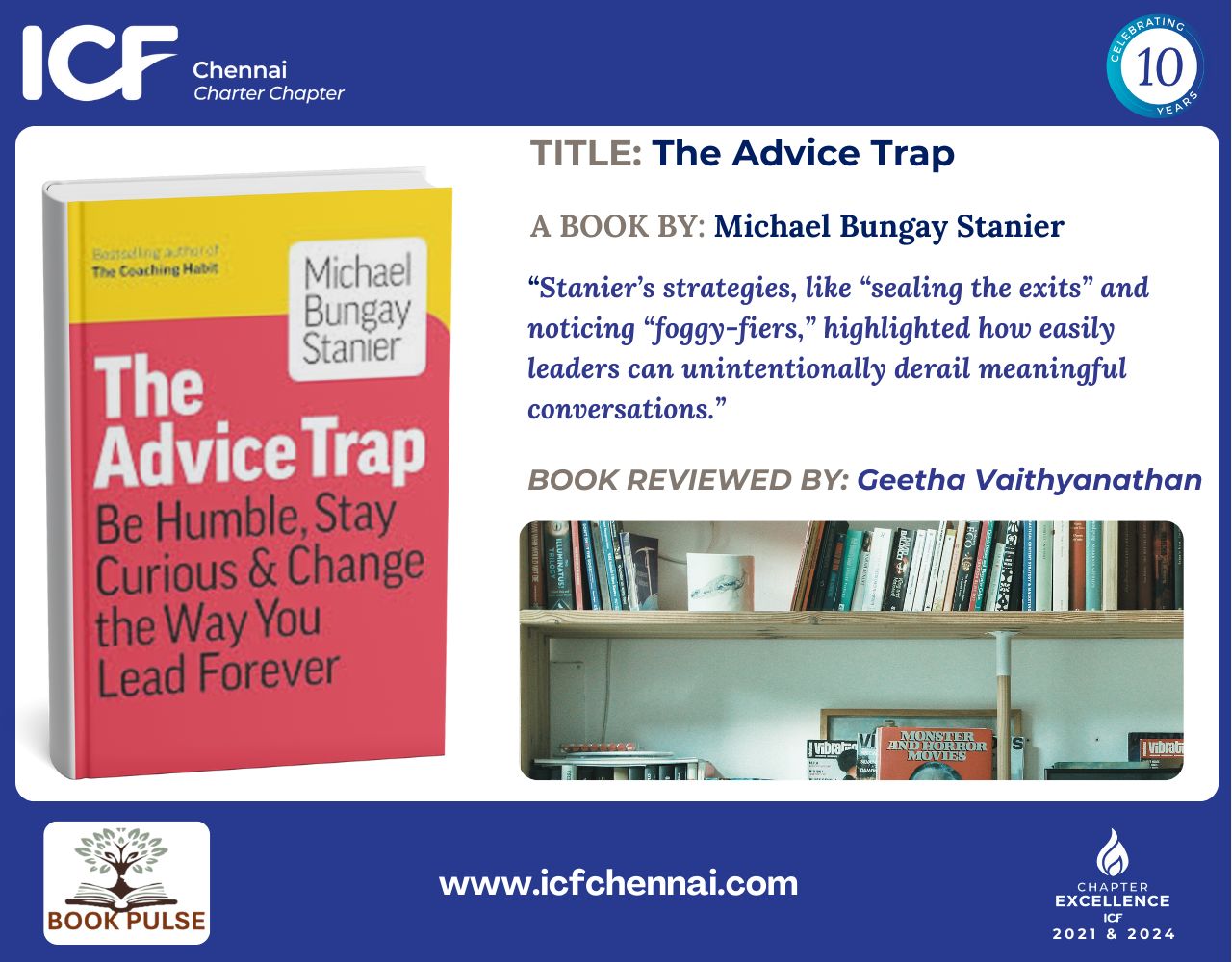
Book review by Geetha Vaithyanathan
Michael Bungay Stanier is an expert in coaching and leadership field. The book “The Advice Trap”, is for Coaches or leaders who want to lead through with humility, curiosity, and impact. His writing in this book is conversational which may not appeal to people looking forward to a formal structure. But the practical tools/strategies that he discusses in this book are easy to apply in daily leadership practice. This book is recommended not only for coaches or leaders, but for consultant, facilitator, mentor, business owner, or counsellor, who is aiming to shift the way they lead their conversations.
Tame Your Advice Monster
The author uses a metaphor of the “Advice Monster”, which is the tendency to offer solutions immediately. He discusses three versions of it in this chapter which may sound familiar to many of us:
- Tell-It: The urge to provide answers immediately
- Save-It: The need to rescue others from struggle
- Control-It: The desire to stay in charge of outcomes
I found Stanier’s concept of the “Advice Monster” both relevant and meaningful. Reflecting on my own habits, I realized how easily this can become a trap in both professional and personal interactions. While it is easier to avoid in a structured coaching sessions, it is true that in other conversations we often aim to add value or maintain control, rather than focusing primarily on the other person’s growth. This pattern is particularly visible in fast-paced environments, where leaders feel pressure to solve problems quickly.
To manage these impulses, I found Stanier’s strategies useful and impactful. They are identifying triggers, noticing patterns, examining the benefits and consequences and visualizing the Future self.
Stay Curious Longer
Stanier in this chapter highlights that the more you make a habit of being curious, the better you get at it. He encourages the readers to “stay curious a little longer” instead of rushing to give advice, slow down your instinct to jump in and investigate what is really at play.
Curiosity should operate as a compass for leaders. Stanier’s strategies, like “sealing the exits” and noticing “foggy-fiers,” highlighted how easily leaders can unintentionally derail meaningful conversations. Stanier’s idea of “foggy-fiers” resonated with me as I experienced how conversations can lose focus when I rush ahead or try to “coach the ghost” instead of addressing what is truly being expressed. “Staying curious a little longer” requires a shift—from leading by direction to leading through dialogue. This aligns with a coaching mindset, where the goal is to empower others to think for themselves rather than control outcomes.
I realized that the use of focus questions to dig deeper and a balance between curiosity and leading is the dual role the leaders have to play. Yet in high-pressure environments, leaders are often challenged between curiosity and action.
Master Your Coaching Habit
The author discusses how values guide a leader towards a coaching style, emphasizing generosity, courage to be vulnerable, and a commitment to growth.
With the help of this chapter, I was able to reflect on how my values shape the leader and coach in me. Generosity is not just about offering your time, but being present and expressing appreciation during a session, the conversation becomes more reflective. A coaching mindset combines curiosity, presence, and belief in clients growth. I was also reminded that developing a coaching mindset in any situation takes patience, self-aware, and comes from consistent practice. I am recognizing that effective leadership require judgement of when to listen, advise, or allow silence.
The book also offers an enriched experience from leaders such as Pau Gasol, Dr. Alex Osterwalder, Dr. Kofi Hope, Feyzi Fatehi, Leanne Hughes, Dr. Shannon Minifie, Sandy McIntosh, and Tyson Yunkaporta. Their voices share how the book’s ideas resonate in different fields — from sports to business to education — adding depth and variety to the experience.
Overall insights
My key takeaway from this book is that shifting from giving advice to staying curious is a challenging change. It is easy to slip into “fix-it” mode, especially in everyday conversations outside structured coaching sessions. As a leader, I see that guidance is sometimes necessary, but the skill lies in balancing when to step in and when to hold back. Real support often means creating space for others to think and act independently. Developing curiosity as a consistent habit—not just in coaching sessions—can transform how I lead.
Stanier’s ideas reflect key ICF competencies: embodying a coaching mindset, cultivating trust and safety, maintaining presence, active listening, evoking awareness, and facilitating growth. True leadership is not about having all the answers—it is about helping others discover their own. So, like Michael Bungay Stanier says, Be lazy. Be curious. Be often.

Geetha Vaithyanathan
The views and opinions expressed in guest posts featured on this blog are those of the author and do not necessarily reflect the opinions and views of the International Coach Federation (ICF). The publication of a guest post on the ICF Blog does not equate to an ICF endorsement or guarantee of the products or services provided by the author.
Additionally, for the purpose of full disclosure and as a disclaimer of liability, this content was possibly generated using the assistance of an AI program. Its contents, either in whole or in part, have been reviewed and revised by a human. Nevertheless, the reader/user is responsible for verifying the information presented and should not rely upon this article or post as providing any specific professional advice or counsel. Its contents are provided “as is,” and ICF makes no representations or warranties as to its accuracy or completeness and to the fullest extent permitted by applicable law specifically disclaims any and all liability for any damages or injuries resulting from use of or reliance thereupon.