

Radical Listening – The Art of True Connection
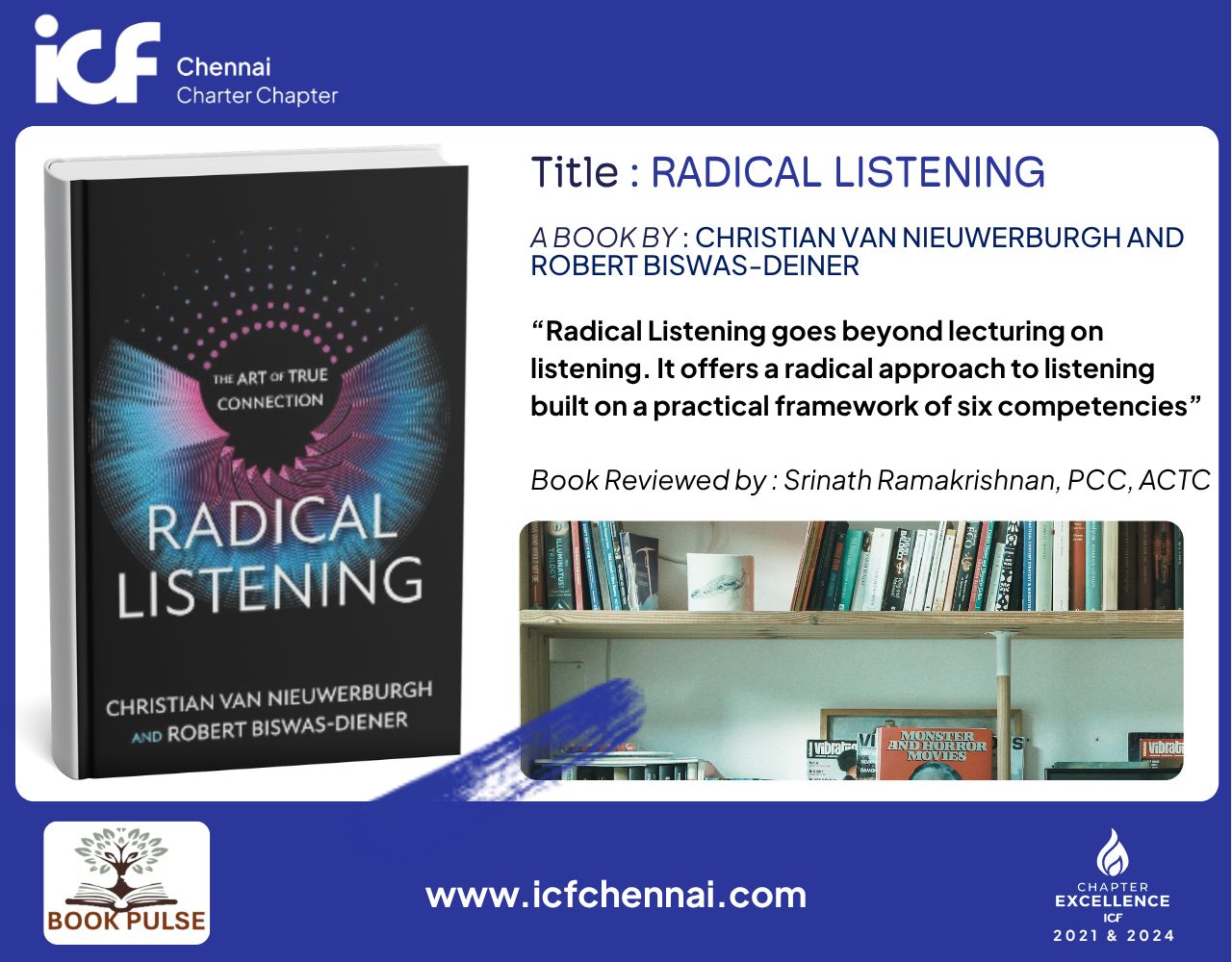
by Christian Van Nieuwerburgh & Robert Biswas-Diener
Book review by Srinath Ramakrishnan
I picked up the book “Radical Listening” after hearing Christian van Neuwerburgh and Robert Biswas-Deiner on several podcasts and YouTube videos — and after multiple accomplished coaches independently recommended it.
We all know about Active Listening — which is about making eye contact, using non-verbal cues, paraphrasing, asking questions etc. Radical listening takes this further. It starts with a positive intention to listen in a way that strengthens rapport. It is not just about listening to comprehend, but “listening to validate, to learn, or to problem solve.” Your intention shapes what you pay attention to.
As the authors put it: “When someone is listened to radically, they feel seen, valued, and heard. And when the connection is real, dialogue – and progress – follows.”
In the modern age, when we are bombarded by data, digital distractions, interruptions, multitasking, and a culture that celebrates talkers over listeners, this book offers six core skills essential to becoming a better listener:
- Noticing – being attentive in conversations, scanning for information and determining what is relevant
- Quieting – bringing a sense of calm by using silences and strategic pauses
- Accepting – adopting openness, respecting others’ rights to hold different opinions and being able to voice them freely
- Acknowledging – offering others the recognition and respect they deserve
- Questioning – asking questions in a way that demonstrates curiosity and genuine interest
- Interjecting – this is “interruption” done well in a purposeful, non-intrusive manner, making observations and asking follow-up questions at the right moment
The book also explores how cultural differences are reflected in the way we communicate, both verbally and non-verbally. Radical listeners develop awareness of these cross-cultural differences and make necessary adjustments.
As a coach, I particularly liked the chapter on questioning. Good questions gather information, show curiosity, build relationships, and provoke new thinking. The authors specifically talk about certain types of questions to avoid, such as cluster questions (stacking multiple questions at once), random questions (poorly framed questions), Trojan horse questions (questions disguised as advice), and rhetorical questions (making a point rather than inviting a response).
What I loved most was the concept of “Micro questions,” which are essentially questions stripped to their essence: “Oh?” “Really?” “What now?” These are highly effective mainly because they demonstrate engagement without being intrusive. Sometimes, just silence can also act as a question.
Why This Book Stands Out
Radical Listening goes beyond lecturing on listening. It offers a radical approach to listening built on a practical framework of six competencies. When you practice radical listening, you create an environment where people feel genuinely heard, valued and respected.
Key Takeaways
- Intentionality is what distinguishes listening from hearing
- Silence is not the absence of conversation – it’s a skill to be deployed in the best conversations
- Interjection isn’t inherently bad – strategic, well-timed interjections signal deep engagement
- There’s a difference between listening for something (themes, emotions, patterns) and listening to someone (to connect, understand, and learn) — and the best listeners do both
- Selective attention can be valuable in listening – filtering out distracting information to stay focused on what matters
- Culture shapes listening norms such as gesturing, smiling, making eye contact and other aspects of communication – what works in one context may land very differently in another
Who Should Read This Book
Anyone who wants to develop their listening skills through a concrete, actionable framework. Listening is something most of us take for granted — this book shows you just how much more there is to listening.
Whether you are a coach, a leader, a facilitator or someone trying to show up better in conversations, this book is well worth your time. It will change how you listen in your very next conversation.

Srinath Ramakrishnan
The views and opinions expressed in guest posts featured on this blog are those of the author and do not necessarily reflect the opinions and views of the International Coach Federation (ICF). The publication of a guest post on the ICF Blog does not equate to an ICF endorsement or guarantee of the products or services provided by the author.
Additionally, for the purpose of full disclosure and as a disclaimer of liability, this content was possibly generated using the assistance of an AI program. Its contents, either in whole or in part, have been reviewed and revised by a human. Nevertheless, the reader/user is responsible for verifying the information presented and should not rely upon this article or post as providing any specific professional advice or counsel. Its contents are provided “as is,” and ICF makes no representations or warranties as to its accuracy or completeness and to the fullest extent permitted by applicable law specifically disclaims any and all liability for any damages or injuries resulting from use of or reliance thereupon.
Thanks Srinath for sharing your review and inputs
Thanks Nitin. Glad you liked the review.