

Coach Builder by Donald Miller
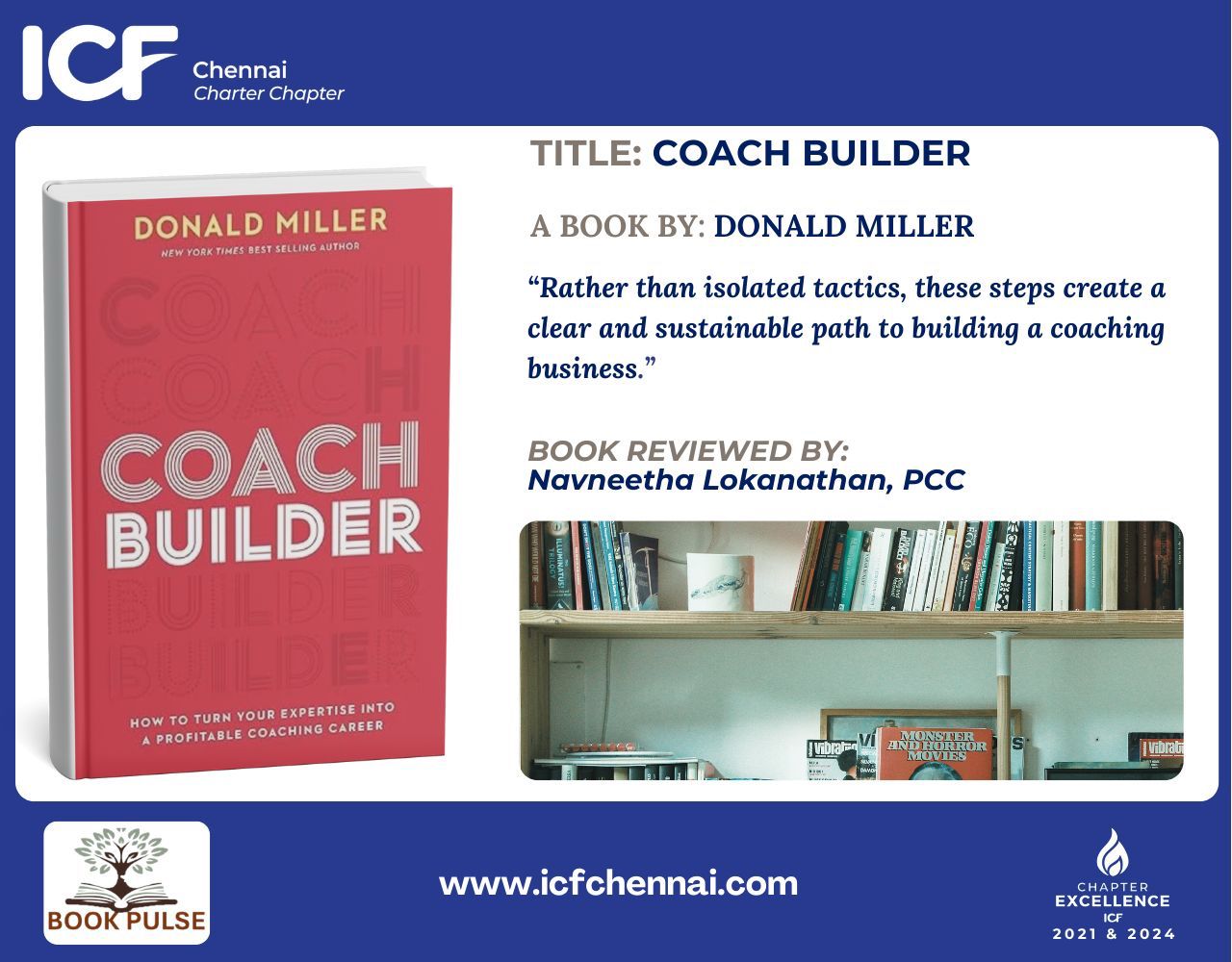
Book review by Navneetha Lokanathan
I was in search of a solid book that could guide me end-to-end in building a coaching business, and that’s when I found Coach Builder by Donald Miller. If you have been like me, trying to build a coaching business, then this book is for you. In fact, this is a book for any business owner trying to grow their business.
Coach Builder
The author outlines eight steps that will help grow your coaching business.
Step 1: Creating a menu of products
Most of us make the mistake of reaching out to prospects without first clarifying what we can offer. But in reality, having clarity on a defined list of products is the first step, which makes decision-making much easier for the prospects. Each product should be easy to understand, deliver extreme value, and be offered at a premium price.
Step 2: Creating and managing a potential client list
Calculating the desired revenue per month and working on the pricing of the defined product list will give an insight into how many clients you need per month. To bring a systematic approach to the business, subscribing to a CRM and nurturing the potential leads through an email campaign is a must. Looked in detail, there are many lead magnets available, such as an assessment, quiz, e-book, or cheatsheet that adds value to your prospects through an email campaign.
Step 3: Making your website a lead generator
If you are building a website for your coaching business, I strongly recommend this chapter alone. A website is an important step in a client’s buying journey and insists that it should flow like a good sales pitch.
The client relationship has three phases: curiosity, enlightenment, and commitment. A website should build enough curiosity and invite them to the enlightenment stage (a webinar, assessment), which in turn helps them commit to working with you when they need. Once the first two phases are addressed, commitment happens organically, without pressure.
Step 4: Writing great emails that close the deal
Using the “Customer is a Hero” framework, any email would directly start with a problem, how could your product solve this problem while painting the negative and positive stakes. And end it with the call to action. When written this way, the email becomes compelling. Different types of emails have to be written at different stages that clearly communicate the value you offer as a coach and align with the problems your prospects are experiencing. . It is also important to state your defined list of products or guide the prospect to the list in your nurturing emails.
Step 5: Mapping out the client journey
The client relationship journey (curiosity, enlightenment, and commitment) and the products at each stage have to be mapped. Curiosity is where we exchange a value with the prospect to get their contact, enlightenment is taking one further by inviting the lead to a webinar and commitment is when they sign up with one of the defined list of products.
Step 6: Setting realistic goals and accomplishing them
Without leads, there is no way to convert prospects into paying clients or build revenue. Setting realistic goals related to marketing efforts and product sales, taking action, and a weekly review of the goals is a must to build a sustainable coaching business. How many qualified leads to connect, how many lead magnets should be downloaded each month, and how many introductory assessment coaching calls are some examples of realistic goals.
Step 7: Joining a coaching community
Being part of an active coaching community supports personal and business growth. We should not overlook the benefits a coaching community can offer. The wisdom and emotional encouragement we get from other coaches can help grow our business.
Step 8: Coaching soft skills
The competencies of a coach and the dos and don’ts of coaching mentioned here align well with ICF competencies. Play the guide, don’t rush through the process, create a safe and trusting environment, be fully present, and affirm the client’s transformation at every level are some of the nuggets from this chapter.
The book ends with what a week in the life of a successful coach looks like and the playbook to build a 7-figure coaching business. These are a great inspiration and guide to stay organised in everyday work routine and build a sustainable coaching business.
Overall Insights
This book opened the door to ideas that are sometimes overlooked in a coaching business. What stood out to me is how the eight steps work together as a complete system—from clarifying what you offer, to generating leads, nurturing relationships, and converting them into long-term clients. Rather than isolated tactics, these steps create a clear and sustainable path to building a coaching business.
As a coach, I plan to implement these steps by first simplifying and clearly defining my coaching offerings, and then intentionally designing my marketing and communication to match where my clients are in their journey.
My biggest insight from this book is that clarity about the products a coach offers is of utmost importance—and that clarity comes from deeply understanding their clients. I am closing this book with great clarity about how I can serve my clients better while also building wealth as a coach.

Navneetha Lokanathan
The views and opinions expressed in guest posts featured on this blog are those of the author and do not necessarily reflect the opinions and views of the International Coach Federation (ICF). The publication of a guest post on the ICF Blog does not equate to an ICF endorsement or guarantee of the products or services provided by the author.
Additionally, for the purpose of full disclosure and as a disclaimer of liability, this content was possibly generated using the assistance of an AI program. Its contents, either in whole or in part, have been reviewed and revised by a human. Nevertheless, the reader/user is responsible for verifying the information presented and should not rely upon this article or post as providing any specific professional advice or counsel. Its contents are provided “as is,” and ICF makes no representations or warranties as to its accuracy or completeness and to the fullest extent permitted by applicable law specifically disclaims any and all liability for any damages or injuries resulting from use of or reliance thereupon.