

Breaking the Habit of Being You by Joe Dispenza
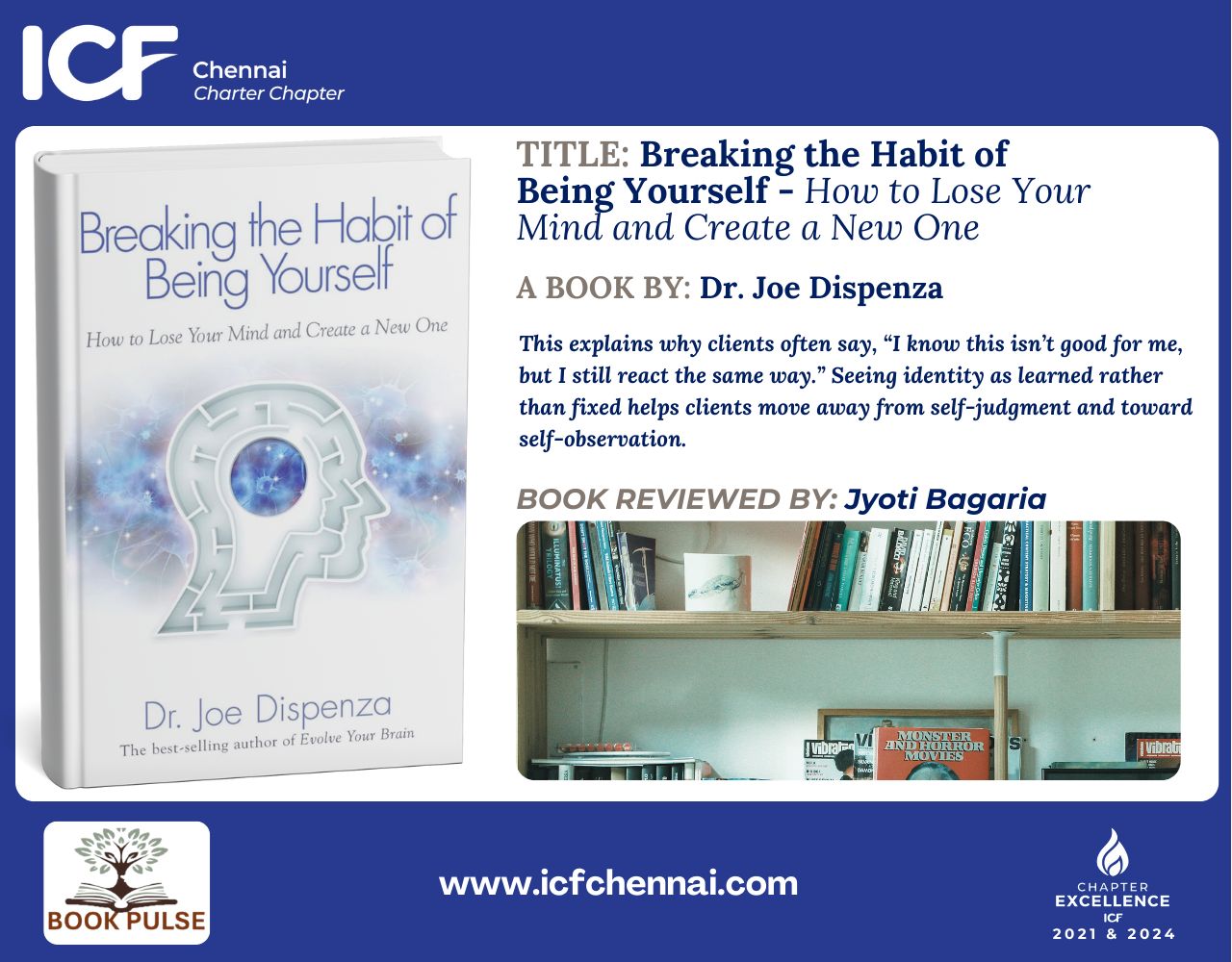
Book review by Jyoti Bagaria
I was looking for a book that could help me understand why change feels so difficult, even for people who are deeply committed to it. As a life coach, I often work with clients who are insightful, motivated, and self-aware, yet find themselves repeating the same emotional and behavioural patterns. Breaking the Habit of Being You addressed this exact gap.
This book is especially relevant for coaches and individuals who want to move beyond surface-level change and understand how thoughts, emotions, habits, and identity work together. It is not only about changing behaviour, but about changing the inner conditions that sustain those behaviours.
About the Book
In Breaking the Habit of Being You, Joe Dispenza explores how our thoughts and emotions form habitual loops that eventually shape our personality and life experiences. The book’s central idea is that who we think we are is largely a product of repeated mental and emotional patterns, not a fixed identity.
Dispenza explains how the brain and body become conditioned to the past. Over time, the body begins to anticipate familiar emotions such as stress, fear, control, or guilt, even before situations arise. This conditioning makes change difficult, not because people lack discipline, but because the nervous system is attached to what feels familiar.
The book combines neuroscience, psychology, and reflective practices to help readers become aware of these patterns and consciously interrupt them. Rather than offering quick fixes, it invites readers to participate actively in the process of inner change.
Key Ideas from the Book (Through a Coaching Lens)
1. Awareness comes before change
A key theme of the book is that awareness is not a preparatory step but the foundation of transformation. Until individuals become conscious of their automatic thoughts and emotional reactions, they continue to operate on autopilot.
From a coaching perspective, this reinforces the importance of slowing down the process. Insight without awareness rarely leads to sustained change.
2. Identity is a habit, not a truth
The book presents identity as a collection of conditioned responses built over time. Thoughts create emotions, emotions condition the body, and the body begins to influence the mind.
This explains why clients often say, “I know this isn’t good for me, but I still react the same way.” Seeing identity as learned rather than fixed helps clients move away from self-judgment and toward self-observation.
3. The body plays a central role in resistance
One of the strongest insights from the book is the role the body plays in maintaining old patterns. Even when the mind wants change, the body may resist because it is accustomed to familiar emotional states.
This perspective aligns well with somatic and awareness-based coaching. It validates why willpower alone is insufficient and why emotional regulation is essential for lasting change.
4. Mental rehearsal and future self
The book also emphasizes mental rehearsal, where individuals intentionally imagine a future version of themselves while experiencing elevated emotional states. This practice helps form new neural pathways.
For coaches, this supports practices such as future self work, visualization, and embodied goal setting. Change becomes more sustainable when clients emotionally experience who they are becoming, not just plan it intellectually.
How the Ideas Work Together
What stood out to me is how these ideas function as a complete system. Awareness helps interrupt unconscious patterns. Understanding identity as a habit reduces self-blame. Working with the body addresses emotional conditioning. Mental rehearsal supports the creation of new possibilities.
Together, these elements create a coherent framework for inner change rather than isolated techniques. This systemic approach makes the book especially valuable for coaches.
My Experience Reading the Book
This is not a light or casual read. Some sections, particularly those involving neuroscience, require attention and reflection. I found myself rereading parts of the book, not because they were confusing, but because their meaning deepened over time.
It is a rereadable book, especially for coaches. Each reading offers new insights depending on one’s stage of personal and professional growth. While the language is accessible, the ideas ask for engagement rather than passive consumption.
How This Book Influenced My Coaching Practice
Reading this book helped me look more closely at the emotional state from which change is attempted. I became more aware of how often clients try to transform themselves through effort, control, or self-criticism.
The book reinforced the importance of creating space for awareness and regulation before moving into action. It also strengthened my trust in stillness, silence, and pacing within coaching sessions. Rather than seeing pauses as unproductive, I now see them as moments where meaningful internal shifts can begin.
Overall Insights
What this book clarified for me is that sustainable change is not about fixing behaviour, but about changing the internal conditions that keep behaviour in place. Resistance is not failure. It is familiarity.
As coaches, this understanding allows us to meet clients with greater compassion and patience. It supports a coaching approach that values awareness, presence, and emotional safety as essential elements of transformation.
My Biggest Takeaways from the Book
- Awareness is foundational, not optional
- Identity is shaped by repeated emotional and mental patterns
- The body often resists change before the mind does
- Sustainable change requires emotional as well as cognitive shifts
- Presence and regulation are powerful tools in coaching
Final Reflection
Breaking the Habit of Being You offers a grounded and thoughtful exploration of why change is often challenging and how it can become more sustainable. It does not promise quick transformation. Instead, it invites responsibility, patience, and self-awareness.
For coaches, this book provides both language and insight to support deeper work with clients. It reinforces that coaching is not about pushing people forward, but about helping them become conscious enough to choose differently.
I am closing this book with a deeper appreciation for the inner work required for real change, both for my clients and for myself.

Jyoti Bagaria
The views and opinions expressed in guest posts featured on this blog are those of the author and do not necessarily reflect the opinions and views of the International Coach Federation (ICF). The publication of a guest post on the ICF Blog does not equate to an ICF endorsement or guarantee of the products or services provided by the author.
Additionally, for the purpose of full disclosure and as a disclaimer of liability, this content was possibly generated using the assistance of an AI program. Its contents, either in whole or in part, have been reviewed and revised by a human. Nevertheless, the reader/user is responsible for verifying the information presented and should not rely upon this article or post as providing any specific professional advice or counsel. Its contents are provided “as is,” and ICF makes no representations or warranties as to its accuracy or completeness and to the fullest extent permitted by applicable law specifically disclaims any and all liability for any damages or injuries resulting from use of or reliance thereupon.