
Lessons to Unleash Hidden Potential
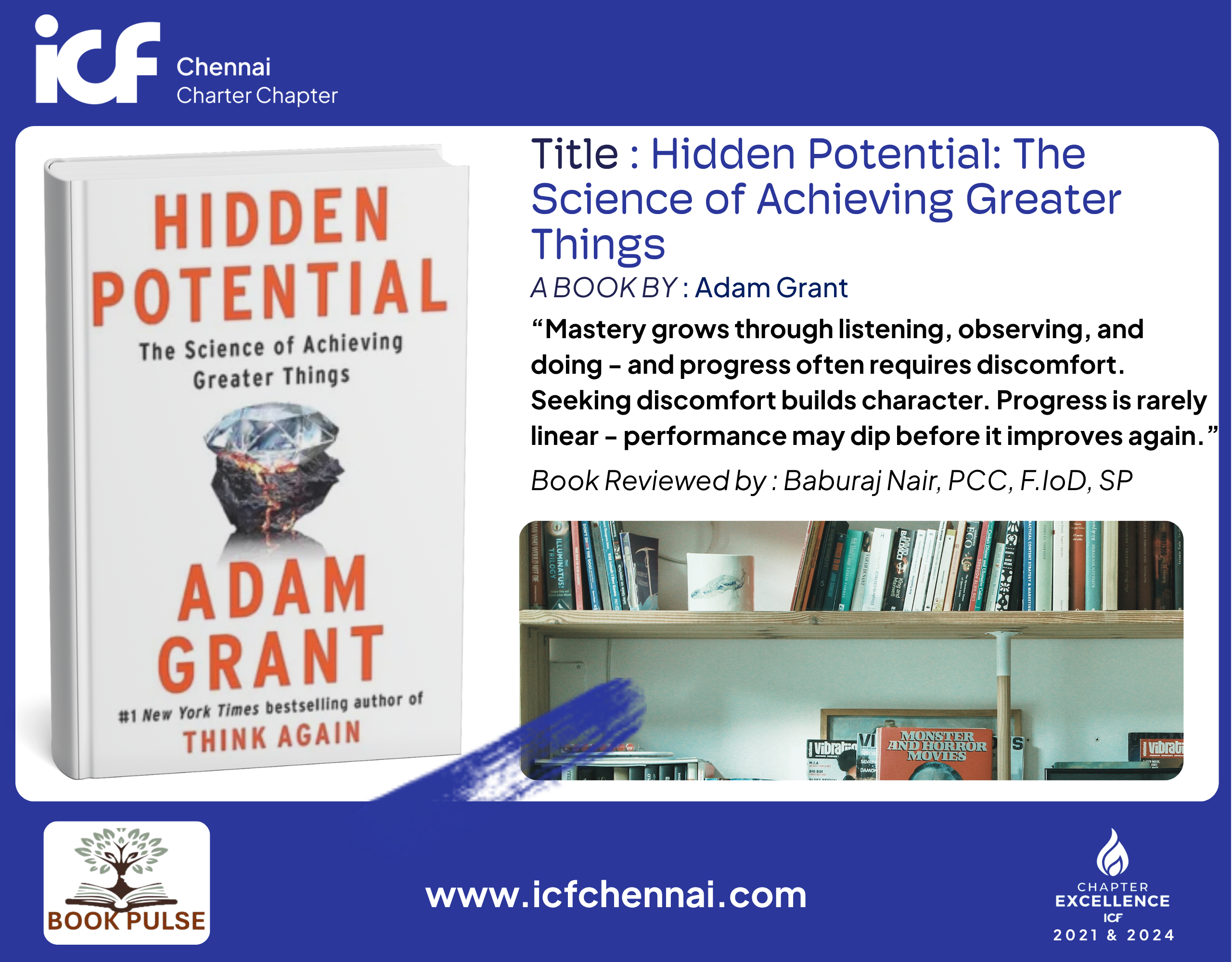
Book review by Baburaj Nair, F.IoD, PCC, S
246 pages and 29 pages of chapter wise research notes !!! Hidden Potential: The Science of Achieving Greater Things by Adam Grant is much more than that!
Divided into 3 sections, the first section explores the specific character that catapult us to greater heights, the second section is about creating structures to sustain motivation, and the third section focuses on building systems to expand opportunities.
Everyone has hidden potential and this book is how we unlock it. This is the fundamental belief; a coach would have. I recommend this book for readers interested in coaching because it offers fresh perspectives on hidden potential and how people grow. The book is especially valuable for coaches because it encourages them to see clients through new lenses and focus on what can be developed, not just what is already apparent.
In Hidden Potential, Adam Grant, a social scientist, cracks open lot of ‘hard-wired’ beliefs in identifying potential. He argues that greatness is less about innate talent and more about character, learning, and the systems that help people grow. Blending research, real life stories, and practical insights, he outlines that potential is not defined by where we begin, but by how far we are willing to stretch, adapt, and persist. He also presents research showing that, more than cognitive ability, qualities such as proactivity, prosocial behaviour, discipline, and determination to tackle difficult problems are key to unlocking hidden potential.
Lessons, I picked up:
- Mastery grows through listening, observing, and doing – and progress often requires discomfort. Seeking discomfort builds character. Progress is rarely linear – performance may dip before it improves again.
- Ask for advice, not just feedback. Hidden potential grows by applying knowledge, not collecting it.
- You do not need perfection; you need a clear, ambitious goal. Perfectionism clings to details, avoids hard tasks, and turns mistakes into self-criticism. Growth takes courage. It comes from accepting flaws, setting realistic standards, and raising them over time. Specific, challenging goals work better than simply trying to “do your best.”
- Procrastination is often emotional avoidance and not just managing time
- Scaffolding matters: timely, tailored, temporary support from others makes growth possible. A growth mindset alone does little good without scaffolding to support it. No one shares your journey, but many can guide it. Blend others’ insights into a path that fits you.
- Work breaks are necessary. It sustains passion, sparks ideas, and deepens learning. Rest and play fuel well-being, focus, and mastery.
- Sense of progress and reading are two strongest factors for intrinsic motivation.
- Low expectations need not hold us back; they can also become fuel to push ourselves forward.
- Collective intelligence thrives under leaders who put mission above ego and make the room smarter. In crises, patient listening matters. Highly narcissistic people often rise to leadership yet prove less effective, making self-serving decisions, promoting a zero-sum view of success, and undermining cohesion and collaboration.
- Teams excel when they share a meaningful mission, recognize mutual dependence, and pursue common goals. Do not mistake confidence for competence, certainty for credibility, or quantity for quality.
- Lattice structures unlock potential by giving people access to multiple leaders and making it safer to speak up. Great leaders build systems that amplify voice. Value life experience, not just résumés. Easy wins can hide ability; hard obstacles often build the skills that matter most.
- Culture is shaped by practices, values, and assumptions: assumptions shape values, and values guide routines. Leaders who understand the work deeply can better attract talent, earn trust, and build strong strategies, while reading fuels intrinsic motivation and learning.
Grant’s emphasis on character over personality, progress over perfection, and guidance over raw ability makes this an engaging and useful read for educators, leaders, parents, and anyone interested in personal growth.
Concise, accessible, and thought-provoking, Hidden Potential is a persuasive reminder that success is not fixed – it can be cultivated. Success is more than reaching our goals-it’s living our values. There’s no higher value than aspiring to be better tomorrow than we are today. There’s no greater accomplishment than unleashing our hidden potential.
What makes the book compelling is its optimistic yet practical message: talent may be widespread, but opportunity and support determine how far people can go.
Happy reading and learning!

Baburaj Nair
The views and opinions expressed in guest posts featured on this blog are those of the author and do not necessarily reflect the opinions and views of the International Coach Federation (ICF). The publication of a guest post on the ICF Blog does not equate to an ICF endorsement or guarantee of the products or services provided by the author.
Additionally, for the purpose of full disclosure and as a disclaimer of liability, this content was possibly generated using the assistance of an AI program. Its contents, either in whole or in part, have been reviewed and revised by a human. Nevertheless, the reader/user is responsible for verifying the information presented and should not rely upon this article or post as providing any specific professional advice or counsel. Its contents are provided “as is,” and ICF makes no representations or warranties as to its accuracy or completeness and to the fullest extent permitted by applicable law specifically disclaims any and all liability for any damages or injuries resulting from use of or reliance thereupon.