
The Inner Game of Tennis – The Classic Guide to the Mental Side of Peak Performance by W. Timothy Gallwey
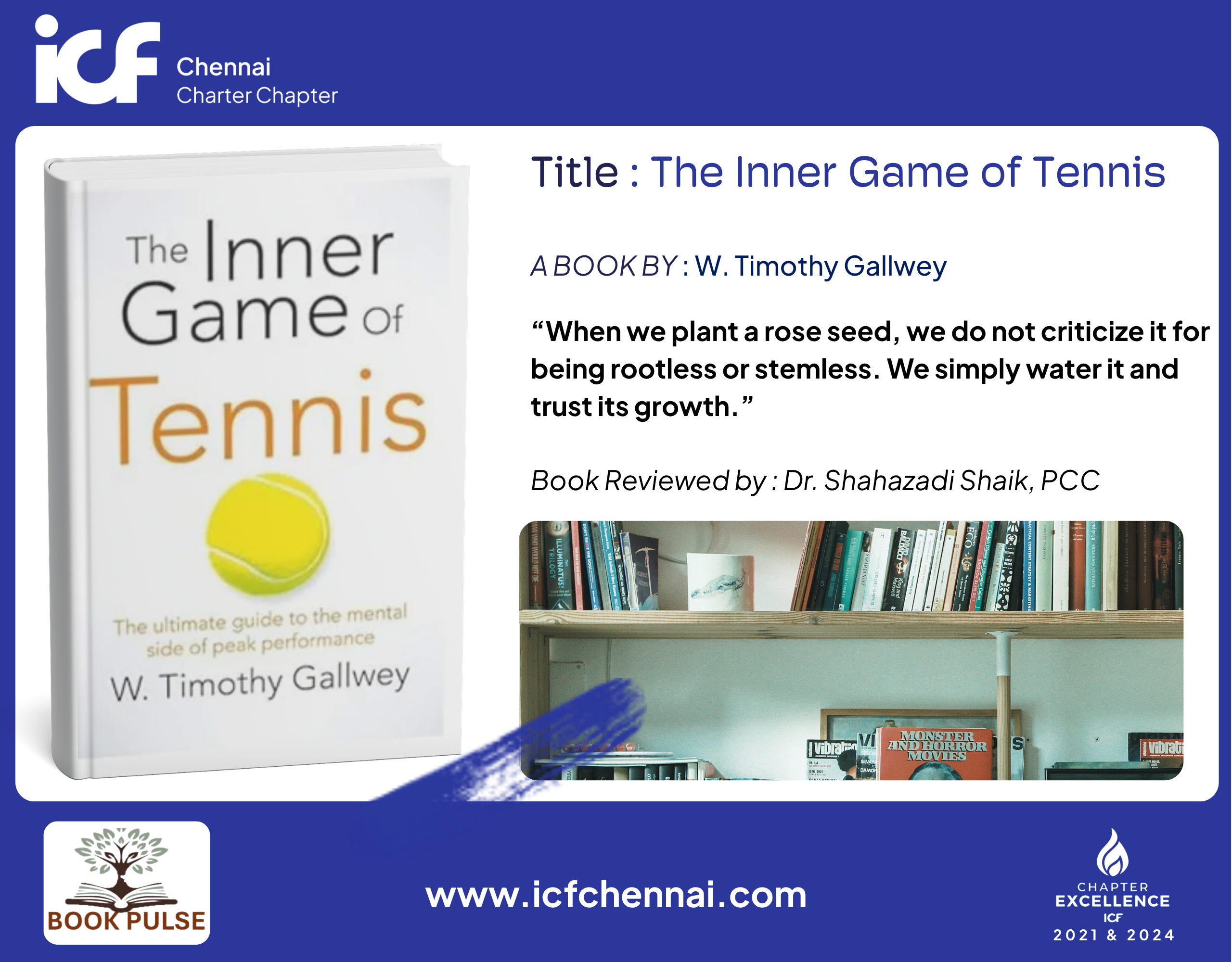
Book review by Dr. Shahazadi Shaik
I picked up The Inner Game of Tennis after hearing it referenced repeatedly in conversations around coaching, leadership, peak performance, and self-mastery. Although written through the lens of tennis, this book is far less about sport and far more about the mind. In many ways, it is a book about how we interfere with our own potential.
Gallwey proposes that every game has two dimensions: the outer game and the inner game. The outer game is played against external opponents and obstacles to achieve external goals. The inner game, however, takes place within the mind and is played against internal obstacles such as self-doubt, nervousness, lapses in concentration, and self-condemnation.
What makes this book so compelling is its central insight:
“The opponent within one’s own head is more formidable than the one on the other side of the net.”
Gallwey argues that peak performance does not come from “trying harder,” but from learning the art of relaxed concentration, a state in which the mind quiets down and the body performs naturally and spontaneously.
One of the most fascinating concepts in the book is the discovery of the “two selves.”
Gallwey describes how most players constantly talk to themselves while playing:
“Keep your eye on the ball.”
“Move your feet.”
“What a terrible shot!”
He calls the voice giving instructions and criticism “Self 1,” the conscious ego-mind, and the performer itself “Self 2,” which includes the body, nervous system, memory, intuition, and accumulated learning.
The tragedy, according to Gallwey, is that Self 1 rarely trusts Self 2.
The more Self 1 overthinks, instructs, criticizes, and interferes, the more tension and conflict it creates in the body. The result is frustration, anxiety, and inconsistent performance. True mastery begins when we learn to quiet Self 1 and trust Self 2.
As Gallwey beautifully suggests, peak performance emerges not from forcing, but from allowing.
The book repeatedly returns to the idea that human beings possess a natural learning process, much like the one through which we learned to walk and talk as children. We learn best not through excessive correction and judgment, but through awareness, observation, trust, and repetition.
I particularly loved the section on non-judgmental awareness.
Gallwey explains how the judgmental mind gradually builds identities around failure. A missed backhand becomes “I have a terrible backhand.” Over time, these judgments harden into self-fulfilling prophecies.
One metaphor from the book stayed with me deeply:
“When we plant a rose seed, we do not criticize it for being rootless or stemless. We simply water it and trust its growth.”
That single image captures the spirit of the entire book. Human potential unfolds naturally when conditions for growth are created.
Another powerful distinction the book makes is between “making it happen” and “letting it happen.” Gallwey argues that excellence often comes when the mind is fully present rather than trapped in fear of failure or obsession with results.
The book also explores habits, learning, concentration, stress, and competition itself. Gallwey reframes competition not as proving superiority over others, but as an opportunity for self-discovery. Opponents are not enemies; they are partners in revealing our hidden capacities.
Why This Book Stands Out
The Inner Game of Tennis is not a technical manual on tennis. It is a philosophy of performance, learning, and self-awareness using the game of tennis as a metaphor.
What makes it timeless is that its principles apply far beyond tennis courts. Whether in leadership, coaching, public speaking, learning, relationships, or work, most of us struggle less with external obstacles and more with the noise within our own minds.
Gallwey provides a remarkably simple yet profound framework for understanding that inner struggle and learning how to move beyond it.
Key Takeaways
- Peak performance comes from relaxed concentration rather than excessive effort
- The mind often interferes with the body’s natural intelligence and learned capability
- Self-judgment creates tension, anxiety, and self-fulfilling limitations
- Awareness without judgment is one of the most powerful tools for growth
- There is a difference between “making it happen” and “letting it happen”
- True confidence develops through trust in one’s natural learning process
- Habits are reinforced grooves of behavior, but new patterns can be created gently and consistently
- Focus grows when attention remains in the present moment rather than drifting toward fear, results, or self-image
- Competition can become a path to self-discovery rather than merely proving superiority
- Inner stability comes from relying less on external validation and more on alignment with one’s deeper self
Who Should Read This Book
Anyone interested in performance, coaching, leadership, learning, mindfulness, or self-mastery.
Whether you are an athlete, coach, leader, facilitator, educator, or simply someone trying to quiet the constant chatter of the mind, this book offers insights that feel both deeply practical and deeply philosophical.
More than a book about tennis, The Inner Game of Tennis is a book about the lifelong journey of learning to trust yourself. And once you begin noticing the battle between Self 1 and Self 2 in your own life, you will never observe your thoughts, habits, or performance in quite the same way again.

Shahazadi Shaik
The views and opinions expressed in guest posts featured on this blog are those of the author and do not necessarily reflect the opinions and views of the International Coach Federation (ICF). The publication of a guest post on the ICF Blog does not equate to an ICF endorsement or guarantee of the products or services provided by the author.
Additionally, for the purpose of full disclosure and as a disclaimer of liability, this content was possibly generated using the assistance of an AI program. Its contents, either in whole or in part, have been reviewed and revised by a human. Nevertheless, the reader/user is responsible for verifying the information presented and should not rely upon this article or post as providing any specific professional advice or counsel. Its contents are provided “as is,” and ICF makes no representations or warranties as to its accuracy or completeness and to the fullest extent permitted by applicable law specifically disclaims any and all liability for any damages or injuries resulting from use of or reliance thereupon.